

CNC Press Brake Forming: How APB Bends Marine Metal with Precision
CNC Press Brake Forming: How APB Bends Marine Metal with Precision
Every custom bracket, hull reinforcement plate, and engine room panel on a yacht starts the same way: as a flat sheet of metal that needs to become something else. The process of getting it there — bending it accurately, repeatably, and without compromising the material — is called press brake forming. And in a marine environment where tolerances are tight and nothing gets a second chance in saltwater, precision is everything.
At All Points Boats (APB), our 3-axis CNC press brake is one of the cornerstones of our fabrication operation at our 30,000 sq. ft. facility in the heart of Fort Lauderdale’s Lauderdale Marine District — part of a broader suite of equipment that includes Florida’s largest 5-axis waterjet, a CNC 4-roll plate roller, and a CNC router.
What Is a CNC Press Brake?
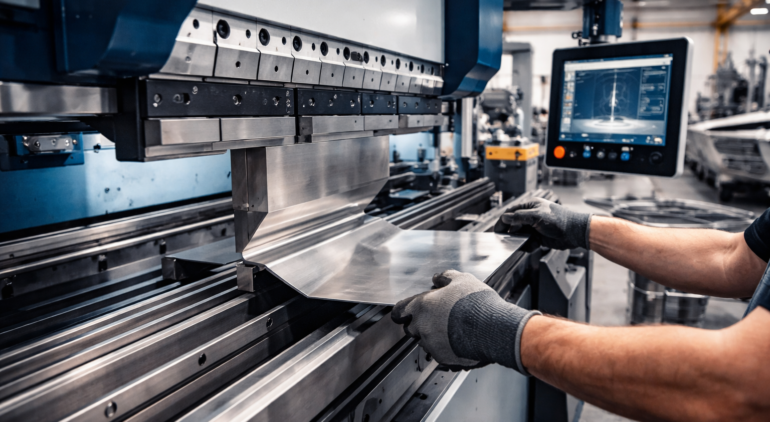
A press brake bends sheet metal by clamping it between a punch (on top) and a die (on the bottom) and applying controlled force. The metal deforms at the contact point, creating a precise angle or shape.
The “CNC” part — Computer Numerical Control — is what separates modern press brakes from manual equipment. Instead of an operator physically setting stops and eyeballing angles, the machine is programmed with exact specifications: bend angle, bend radius, back gauge position, material type, and thickness. The 3-axis designation means the machine independently controls three axes of movement, automatically repositioning between bends in a sequence without manual intervention.
The practical result: a complex part requiring multiple bends at different angles can be produced in a single setup, with each bend executed to the same specification every time — whether it’s the first part or the fiftieth.
Why Precision Matters in Marine Fabrication
On a yacht, imprecision compounds. A bracket formed 2 degrees off spec means the equipment it supports sits slightly crooked. A panel with inconsistent bend radii doesn’t seat flush against the hull. A through-hull fitting flange that’s out of plane leaks.
CNC press brake forming addresses this directly. Because the machine is programmed rather than manually set, every bend in a run is identical. Modern CNC controllers also account for material spring-back — the tendency of metal to partially return toward its original shape after bending — so the finished angle is what was specified, not an approximation of it.
This matters especially when working with stainless steel, aluminum, copper-nickel (CuNi), and bi-metallic assemblies. Each material has different spring-back characteristics, different yield points, and different sensitivities to work hardening. A CNC press brake handles these variables systematically rather than through trial and error.
What APB Produces on the Press Brake
Structural brackets and gussets — engine mounts, thruster supports, and generator saddles all require precise bend geometry to distribute load correctly. A bracket that’s a few degrees off will develop fatigue cracks under engine vibration over time.
Hull penetration flanges — through-hull fittings, sea chest cover plates, and overboard discharge flanges are formed to match exact hull geometry. These are safety-critical components where a poor fit creates a leak path below the waterline.
Custom handrail and platform components — APB fabricates the angle brackets, end caps, and base plates that make up custom stainless handrails, swim platforms, and boarding gates, all formed to match each vessel’s specific geometry.
Tank components — side panels, baffles, and end caps for fuel, water, and ballast tanks are formed on the press brake before being welded and hydrostatic pressure tested to class certification standards.
Engine room panels — insulation backing, heat shields, cable tray sections, and equipment enclosures all need to fit within tight confines and interface correctly with adjacent systems.
How It Fits Into APB’s Fabrication Workflow
The press brake rarely works alone. Most jobs move through several steps: APB engineers the part in SolidWorks, the waterjet cuts the flat blank to net shape, the press brake bends it to final geometry, certified welders complete any assembly welding, and the finished part goes through dimensional inspection or pressure testing before leaving the shop.
This integrated workflow — design, cutting, forming, welding, and testing all under one roof — is what allows APB to turn around custom components faster than operations that outsource any step in the process.
The same capability that serves superyacht fabrication also serves non-marine clients. If your project needs precision-formed stainless, aluminum, or steel components — marine or otherwise — APB’s machine shop is available for contract work.
Ready to discuss a fabrication project? Contact APB at (954) 767-8255 or visit apb1.com/request-a-quote
All Points Boats — 900 SW 21st Terrace, Fort Lauderdale, FL 33312